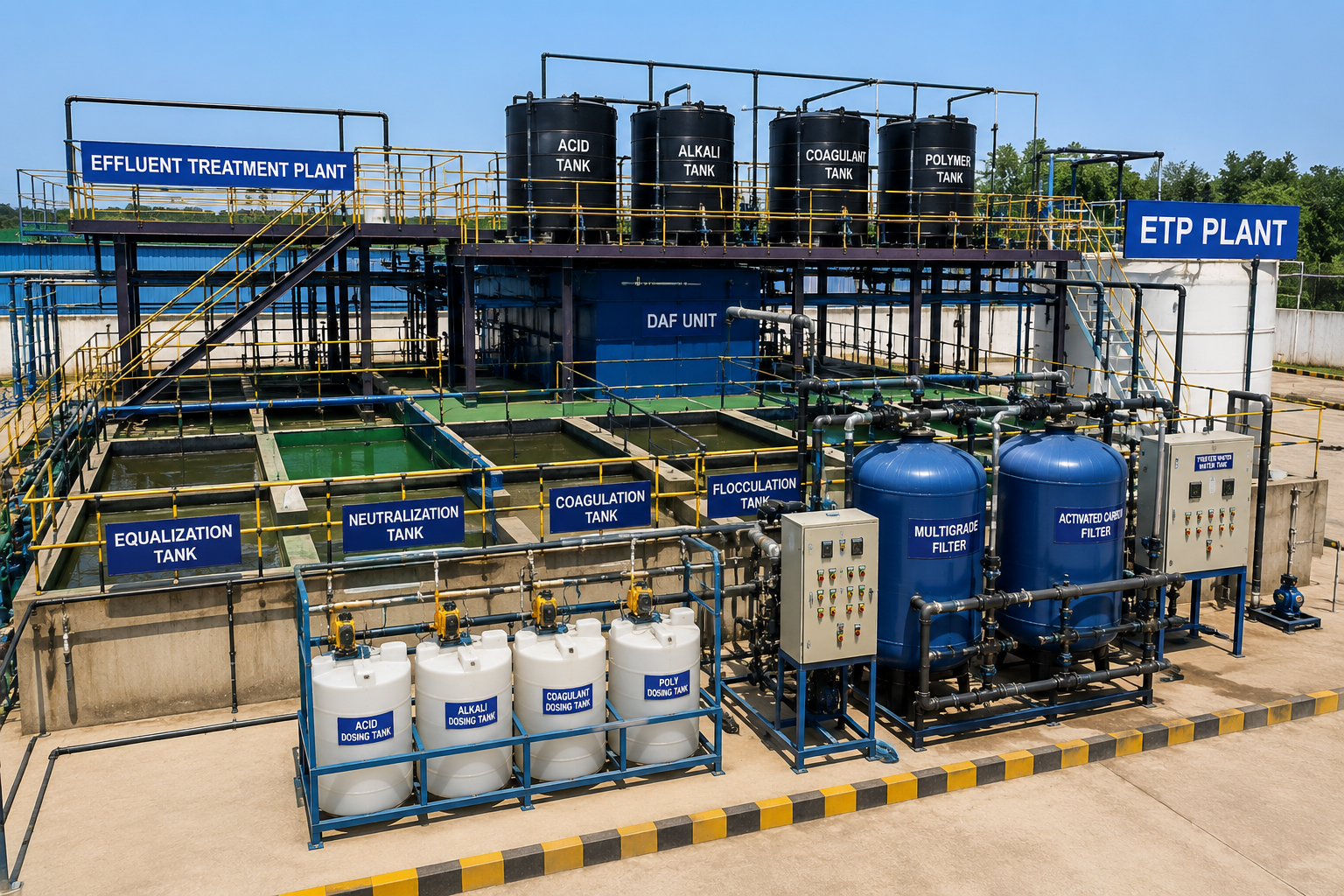
An Effluent Treatment Plant (ETP) is a wastewater treatment system designed to treat industrial and process wastewater before its discharge, reuse or further treatment.
Industrial effluent may contain suspended solids, oil & grease, organic pollutants, chemicals, colour, dissolved contaminants and other process-specific impurities.
An ETP uses an appropriately designed combination of physical, chemical and biological treatment processes to reduce these pollutants.
Since wastewater characteristics vary significantly from one industry to another, every ETP should be designed according to the influent characteristics, flow rate, required treated-water quality and applicable discharge/reuse requirements.
An ETP generally combines multiple treatment stages according to the characteristics of the industrial wastewater.
Raw industrial effluent first passes through a screen chamber to remove large floating and suspended materials such as plastic, fibres, cloth and other process debris.
Proper screening protects pumps, pipelines and downstream treatment equipment.
Where required, an Oil & Grease Trap or Oil Separator is provided to remove free oil, grease and floating contaminants.
Grit and heavier inorganic particles can also be removed at this stage.
Wastewater is collected in the Equalization Tank to balance fluctuations in flow, pH, temperature, organic load, chemical concentration and pollutant load.
Mixing or aeration is provided as appropriate to maintain uniform wastewater characteristics and prevent unwanted settling.
Industrial effluent may be acidic or alkaline. Suitable acid or alkali dosing is provided to bring wastewater into the required pH range for subsequent treatment.
Actual chemicals and dosing quantities depend on wastewater characteristics.
A suitable coagulant is added to destabilize fine suspended and colloidal particles present in the wastewater.
Rapid mixing helps disperse the chemical throughout the wastewater.
After coagulation, gentle mixing helps smaller particles combine and form larger flocs.
A suitable flocculant or polymer may be dosed where required.
Chemically formed flocs are separated from wastewater through sedimentation or clarification.
Settled sludge is collected at the bottom and transferred to the sludge-handling system.
Where biodegradable organic matter is present, biological treatment can be provided using suitable technologies.
Microorganisms consume biodegradable organic pollutants and help reduce BOD and COD.
Where the selected biological process requires clarification, treated wastewater flows to a Secondary Clarifier where biological solids are separated from the water.
The exact arrangement depends on the biological technology selected.
Clarified water can be passed through a Pressure Sand Filter (PSF) for tertiary polishing and reduction of residual suspended impurities.
Water can pass through an Activated Carbon Filter (ACF) where required for polishing, including reduction of certain residual organics, colour and odour.
Actual performance depends on contaminants present and carbon selection.
Depending on the required final water quality, additional treatment may include:
Where microbiological control is required, treated water can be disinfected using chlorination, sodium hypochlorite, UV or another suitable technology.
Final treated effluent is collected in a Treated Water Tank.
Depending on achieved quality, the water can be reused, recycled, sent for further treatment or discharged according to applicable requirements.
Sludge generated from chemical and biological treatment is collected separately for proper handling.
Sludge characteristics should be assessed before selecting the final handling and disposal method.
Helps reduce contaminants present in process wastewater.
Designed to reduce parameters such as suspended solids, oil & grease, BOD, COD and other treatable contaminants.
ETP configuration can be specifically designed according to the characteristics of each industry's wastewater.
Treated effluent can be further processed for suitable industrial reuse applications.
Recycling treated wastewater can reduce dependence on fresh-water sources.
Physical, chemical, biological and membrane processes can be combined according to project requirements.
ETPs can be engineered for different wastewater flows and industrial capacities.
A properly designed and operated ETP helps industries achieve applicable wastewater discharge or reuse requirements.
ETP-treated water can be further processed through UF, RO and ZLD systems where higher recovery or zero-liquid-discharge objectives are required.