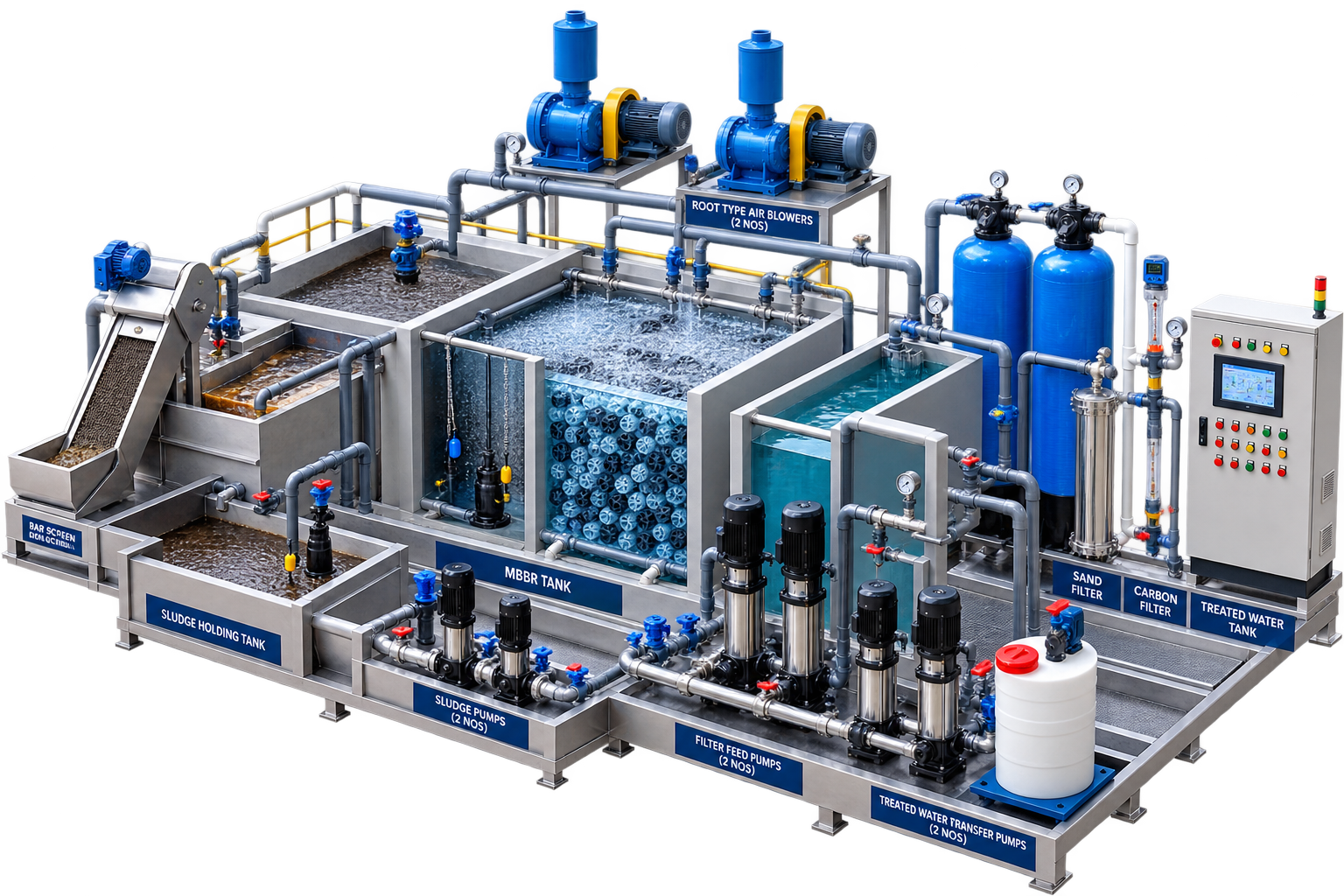
MBBR (Moving Bed Biofilm Reactor) is an advanced biological wastewater treatment technology designed for efficient treatment of domestic and commercial sewage.
The process uses specially designed floating bio-media inside the aeration tank. Beneficial microorganisms grow on the surface of these media and form an active biofilm, which continuously breaks down organic pollutants present in wastewater.
MBBR technology provides a compact, efficient, stable and flexible treatment system and is widely used in Sewage Treatment Plants (STPs) for both new installations and plant upgradation.
MBBR works on the principle of attached biological growth using specially designed floating bio-media.
Special plastic bio-media are placed inside the MBBR aeration tank, where they remain continuously suspended and moving with the help of air supplied through fine-bubble diffusers.
Microorganisms develop on the protected surface of the media and consume biodegradable organic matter present in sewage.
This biological activity helps reduce BOD, COD and other organic pollutants.
Air supplied through the fine-bubble diffusers provides oxygen and keeps the bio-media continuously moving inside the biological reactor.
The treated wastewater is separated from biological solids through secondary clarification, followed by tertiary filtration and disinfection as required.
Raw sewage first passes through a screening system to remove large floating materials such as plastics, cloth, paper and other debris.
Oil, grease, grit and other unwanted materials are removed where required to protect downstream treatment equipment.
Screened sewage is collected in the equalization tank to balance variations in flow and pollutant concentration. Mixing or aeration keeps the wastewater homogeneous.
Wastewater enters the MBBR tank containing specially designed floating bio-media. Air supplied through diffusers provides oxygen and keeps the media continuously moving.
Microorganisms growing on the media form an active biofilm and biologically degrade the organic pollutants present in sewage.
The biologically treated water flows to a secondary clarifier, where suspended biological solids are separated from the treated water.
Clarified water is further polished through a Pressure Sand Filter (PSF) and Activated Carbon Filter (ACF) to improve clarity and overall treated-water quality.
Treated water is disinfected using a suitable system such as chlorination, sodium hypochlorite dosing or UV, depending on project requirements.
After suitable treatment and disinfection, treated water can be reused for approved non-potable applications such as gardening, flushing, landscaping and utility purposes.
Effective biological reduction of biodegradable organic pollutants.
High concentration of active biomass can be maintained on the bio-media.
Attached biofilm provides reliable and stable biological treatment.
Suitable for continuous-flow sewage treatment applications.
Can be designed for different plant capacities and wastewater loads.
Suitable for increasing biological treatment capacity in many existing systems.
Biofilm-based treatment provides operational robustness against normal load variations.
Pure MBBR systems do not normally depend on conventional return activated sludge for biomass retention.
Can be integrated with tertiary treatment and disinfection for non-potable reuse applications.
MBBR technology based STPs can be designed for a wide range of residential, commercial, institutional and municipal applications.