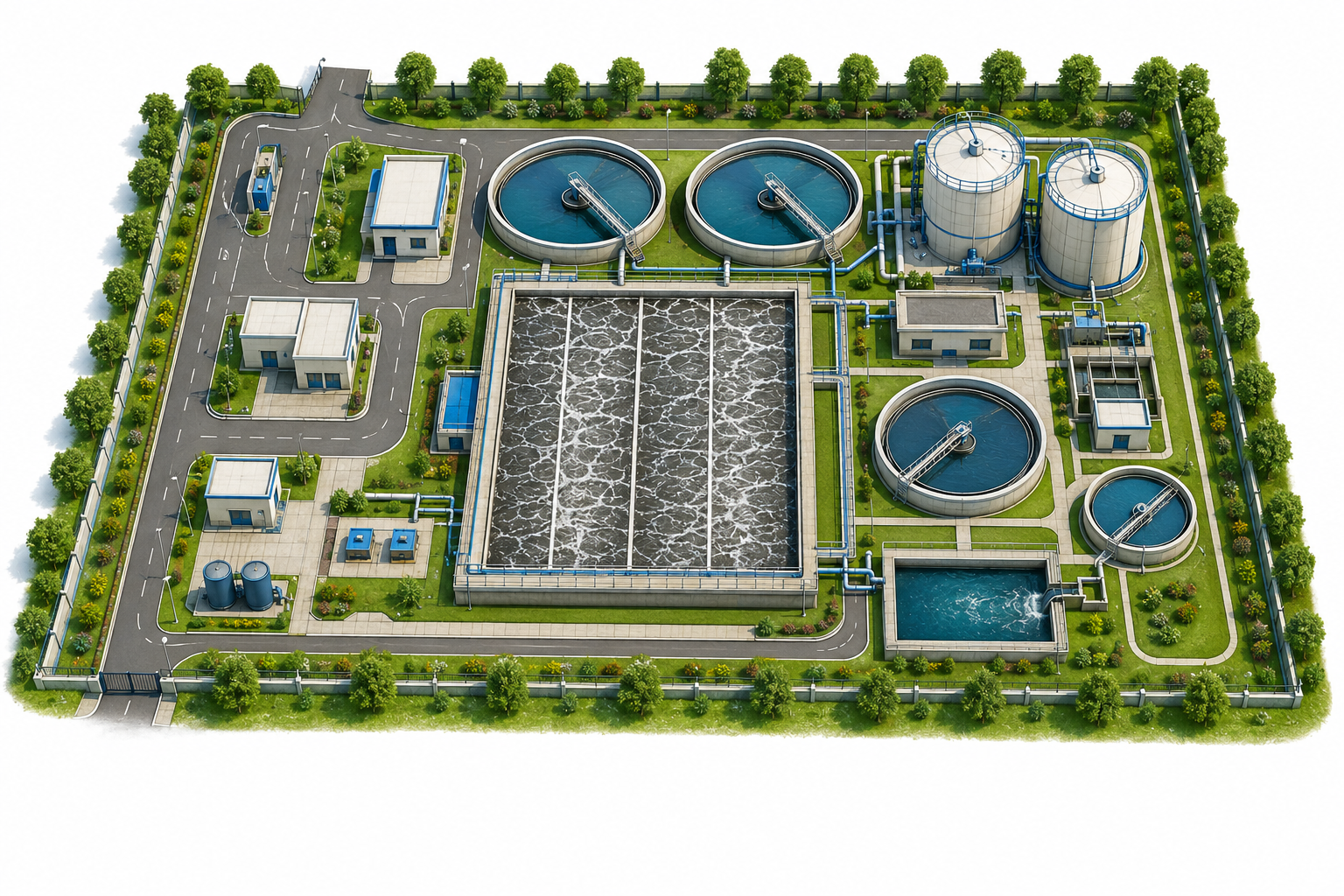
A Sewage Treatment Plant (STP) based on Sequencing Batch Reactor (SBR) Technology is an advanced biological wastewater treatment system designed for the effective treatment of domestic and municipal sewage.
SBR is a modified Activated Sludge Process in which biological treatment, aeration, settling and clarification are carried out sequentially within the same reactor. The complete treatment process operates through programmed cycles, providing efficient treatment with a compact plant configuration.
SBR technology is suitable for residential developments, hotels, hospitals, institutions, commercial complexes, industries, townships and municipal sewage treatment applications.
A controlled biological treatment cycle designed for efficient sewage treatment.
Pre-treated sewage is transferred into the SBR basin. During this stage, incoming wastewater comes in contact with the active biomass already present inside the reactor.
Depending on the treatment requirement, mixing and/or aeration can be provided during the filling stage.
During the reaction stage, air is supplied through an aeration system, generally consisting of air blowers and fine-bubble diffusers.
The oxygen supplied to the reactor supports the growth and activity of aerobic microorganisms. These microorganisms biologically degrade the organic pollutants present in sewage and help reduce the BOD and COD load.
The operating cycle can also be configured to promote nitrification and denitrification for improved nitrogen removal.
After completion of the biological reaction, aeration and mixing are stopped.
Under calm conditions, activated sludge settles at the bottom of the SBR basin while clarified treated water forms in the upper portion of the reactor.
Because settling occurs in the same biological reactor, a separate conventional secondary clarifier may not be required.
After proper settling, the clarified supernatant is removed from the upper portion of the reactor through a controlled decanting system.
The decanter is designed to withdraw treated water while minimizing disturbance of the settled biomass.
The decanted water can then be sent for tertiary treatment and disinfection depending upon the required treated-water quality and reuse application.
The idle period prepares the reactor for the next treatment cycle.
Excess biological sludge generated during treatment is periodically withdrawn to maintain the required biomass concentration and sludge age inside the system.
The reactor then starts the next programmed cycle.
Excess sludge from the SBR system is transferred to the sludge handling system for further treatment/dewatering and disposal as applicable.
Biological treatment and secondary clarification are performed sequentially in the same reactor, reducing the requirement for multiple separate treatment tanks.
Properly designed and operated SBR systems provide effective reduction of biodegradable organic matter and suspended solids.
Fill, aeration, reaction, settling and decanting durations can be adjusted according to sewage characteristics and required treated-water quality.
The operating sequence can incorporate aerobic, anoxic and/or anaerobic conditions to support biological nitrogen and phosphorus removal.
Settling occurs directly inside the SBR basin, simplifying the conventional activated-sludge treatment configuration.
Controlled quiescent settling conditions allow activated biomass to settle before the treated supernatant is decanted.
Cycle operation provides operational flexibility for applications experiencing variations in sewage flow and organic loading.
SBR plants can be operated through PLC/timer-based automation controlling pumps, blowers, valves, decanters and treatment stages.
Depending on applicable standards and tertiary treatment, treated sewage can be reused for various non-potable applications.
SBR based Sewage Treatment Plants can be designed for a wide range of residential, commercial, institutional and municipal applications.