MBR (Membrane Bioreactor) is an advanced wastewater treatment technology that combines biological treatment with membrane filtration to produce high-quality treated water.
In an MBR system, microorganisms biologically degrade organic pollutants present in sewage, while microfiltration or ultrafiltration membranes separate treated water from suspended solids and biomass.
The technology provides a compact, efficient and high-performance treatment solution, particularly where high treated-water quality, water reuse and limited installation space are important.
MBR technology combines biological treatment with advanced membrane filtration.
Wastewater is biologically treated in an aeration / biological reactor where microorganisms consume biodegradable organic matter and reduce pollutants such as BOD and COD.
The biologically treated mixed liquor then comes into contact with membrane modules.
The membranes act as a physical barrier, allowing treated water to pass through while retaining biomass and suspended solids inside the treatment system.
Membrane filtration replaces conventional gravity clarification in many MBR configurations and provides highly effective separation of suspended solids and biomass from treated water.
The membrane-filtered water can undergo further disinfection depending on the required treated-water quality and reuse application.
Raw sewage first passes through a suitable screening system to remove plastics, cloth, hair, fibres and other coarse materials.
Fine screening is particularly important in MBR systems to protect membrane modules from clogging and damage.
Oil, grease, grit and other unwanted materials are removed where required to protect the biological process, pumps and membrane system.
Screened sewage is collected in the equalization tank to balance variations in wastewater flow and pollutant concentration.
Mixing or aeration may be provided to maintain homogeneous conditions and prevent unwanted settling.
Equalized wastewater enters the biological reactor, where microorganisms biologically degrade biodegradable organic pollutants.
Air supplied through diffusers provides the oxygen required for microbial activity and helps maintain proper mixing conditions.
The biologically treated mixed liquor is filtered through Microfiltration (MF) or Ultrafiltration (UF) membranes.
The membrane retains suspended solids and biomass while allowing clarified treated water to pass through.
Filtered water passing through the membrane is known as permeate and is collected in the treated-water tank.
Membrane separation allows very low suspended solids when the system is properly designed and operated.
Depending on the required reuse standard, treated water may undergo additional disinfection using UV, chlorination, sodium hypochlorite dosing or another suitable system.
After achieving the required treated-water quality and disinfection, the water can be reused for suitable non-potable applications.
Membranes require periodic maintenance cleaning to control fouling and maintain permeability.
Depending on system design, cleaning may include air scouring, relaxation / backwashing and periodic chemical cleaning.
Membrane filtration provides excellent separation of suspended solids and biomass.
MBR systems can eliminate conventional secondary clarification and allow compact plant layouts.
Membranes provide a physical barrier between biological solids and treated water.
High-quality treated effluent makes MBR attractive for reuse-oriented projects.
The membrane retains biomass within the biological treatment system, allowing operation at relatively high mixed-liquor concentrations.
Membrane separation performs the solid-liquid separation function.
Physical membrane separation helps provide stable effluent quality when properly operated.
Membranes significantly restrict suspended solids from passing into the permeate.
Suitable for projects where available land or plant-room space is limited.
Membrane systems can be configured in modules according to plant capacity and future requirements.
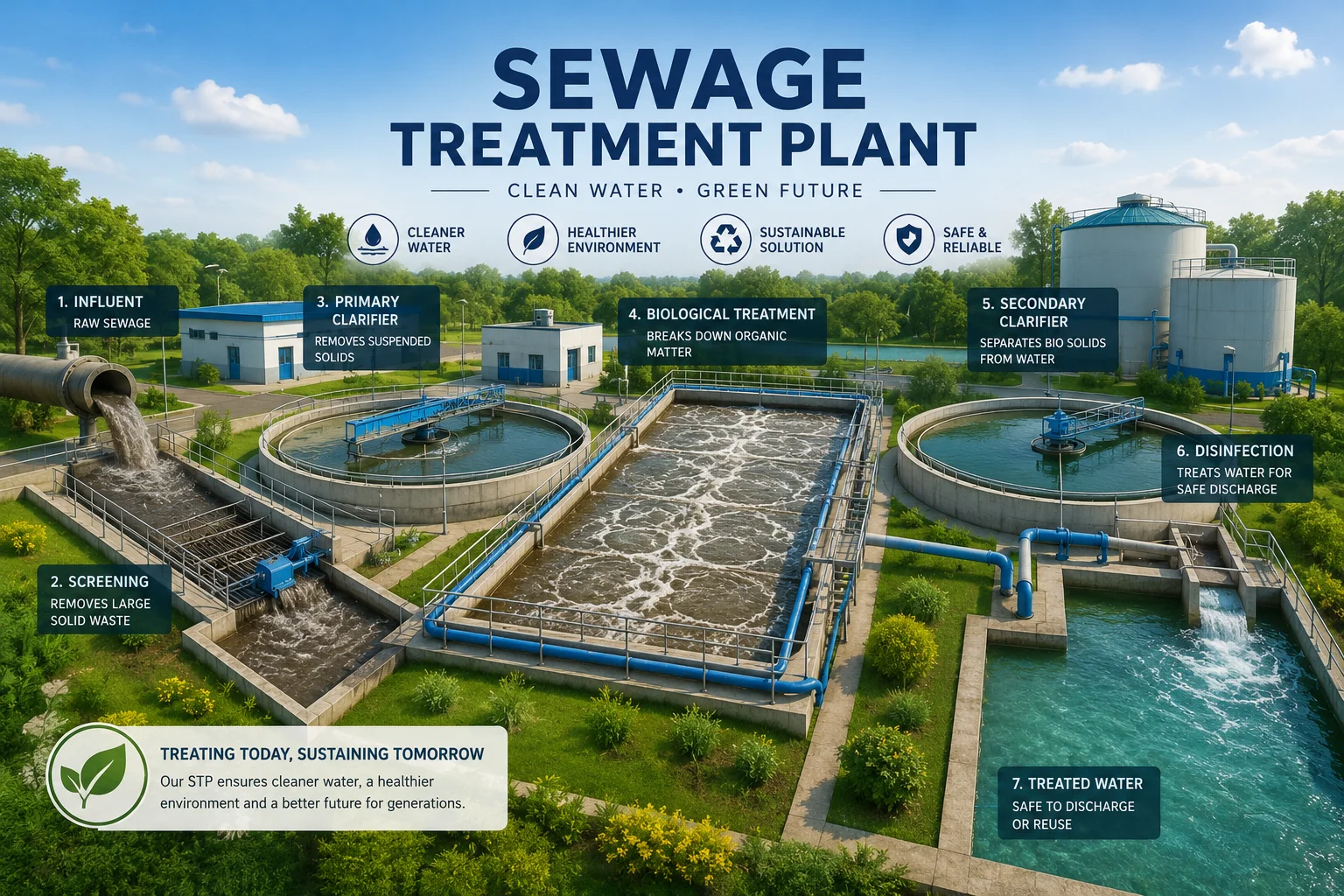
A conventional biological STP generally relies on gravity clarification for separating biomass from treated wastewater.
In an MBR system, membrane filtration replaces conventional secondary clarification and provides enhanced physical separation of suspended solids and biomass.
MBR is particularly suitable where high treated-water quality, compact footprint and maximum water reuse are key project requirements.